

Bonjour REIMS!

Bonjour REIMS!

Reims Art Deco Trail: 16 Stops on Foot

Les Halles du Boulingrin - REIMS

Visitor Guide

Reims Art Deco

The grand walking trail in 16 stops — look up!

Everyone comes to Reims for the cathedral and the Champagne cellars. That is perfectly valid, and well deserved. But between the Gothic cathedral and the first glass of bubbles, there is an entire city to look at — and not just any city. Reims has one of the densest and best-preserved Art Deco heritages in France>, a direct legacy of its reconstruction after the First World War.

In 1918, the City of Coronations was 80% destroyed. In less than twenty years, it rose again from the ground up — and it did so with style. Architects, master glaziers, ironworkers, mosaicists: the finest craftsmen of the interwar period converged on Reims to build a new, modern, and deliberately beautiful city. The result? A city centre that resembles an open-air museum, provided you know where to look.

This trail takes you from the Boulingrin Market Hall all the way to the Église Saint-Nicaise, along the great rebuilt thoroughfares, pausing in period brasseries and tea rooms, and regularly lifting your eyes to ceilings that many of the people of Reims themselves have never seen. Allow a full day (6 to 8 hours) for all 16 stops — roughly 4 to 5 km on foot through the city centre, with the final two stops requiring transport or an extra 30 minutes' walk. Comfortable shoes are essential, along with a willingness to walk slowly.
1

Boulingrin Market Hall — the starting point

Place du Boulingrin, 51100 Reims

Market: Friday 7am–1pm · Saturday 6am–2pm

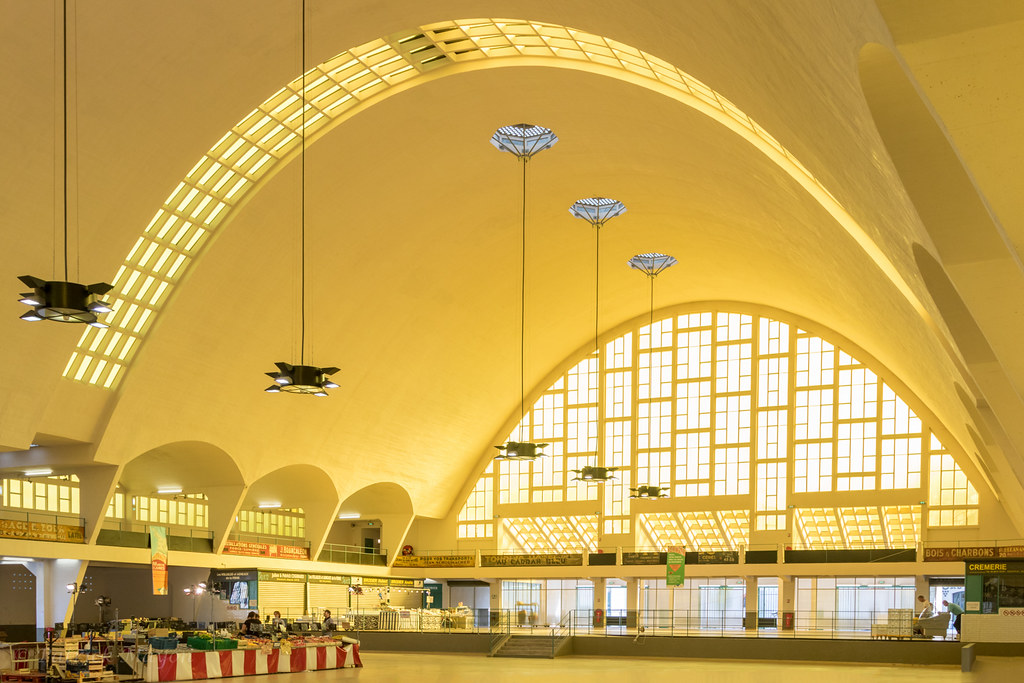
Start early — ideally on a Friday or Saturday morning, to see the Market Hall in full use. This great reinforced concrete vessel, inaugurated in October 1929, is an engineering feat by architect Émile Maigrot: its parabolic vault spans 38 metres without a single central support — a technical gamble that many at the time considered reckless. Reinforced concrete was still a material that traditional architects regarded with suspicion; Maigrot proved them spectacularly wrong.

What is less well known: in the 1980s, the Market Hall nearly came down. Left to decay for years after the deindustrialisation of the neighbourhood, it was saved at the last moment, listed as a Historic Monument, then restored and returned to its market use. Today, beneath this vault that amplifies voices and the sounds of the stalls, you find Champagne cheeses, local market gardeners, charcuterie and flowers. It is the ideal place to understand from the outset that Reims's Art Deco was never merely an aesthetic affair: it is an architecture of everyday life, in the service of real living.

2

Le Cellier — the most spectacular façade in Reims

4 bis, Rue de Mars, 51100 Reims

Façade visible at all times · Programme at reims.fr

Walking 200 metres down the Rue de Mars, you come upon a façade that stops you in your tracks. Le Cellier, built in 1898 by architect Ernest Kalas for the Champagne house Jules Mumm, is today a municipal cultural venue — but its exterior, listed as a Historic Monument since 1997, remains one of the most spectacular in the city.

Five large mosaic panels by Auguste Guilbert-Martin illustrate the stages of Champagne production: harvesting, pressing, bottling, riddling, disgorgement. A large circular metal door evokes the shape of a wine vat. Four sculpted caryatids embody the virtues of wine — Virtus, Ingenium, Amor, Gaudium — with a gravity that gives you a slight urge to open a bottle on the pavement. A delightful detail: these solemn allegories adorn what was, first and foremost, a dispatch warehouse. Mumm wanted even his loading bays to have presence. It is hard to argue with him.

3

Les Galeries Rémoises — a rescued Art Deco façade

7, Rue du Docteur-Jacquin, 51100 Reims

Viewable from the street

200 metres further south, the façade of the Galeries Rémoises (Margotin & Roubert, interwar period) has survived every successive conversion of the building. Originally a department store competing with Au Petit Paris, it later became the Reims Printemps before that too closed in 2003, and was subsequently converted into housing. But the Art Deco façade remained — and with it, something rare: the engraved sign "Galeries Rémoises — Maison Lorin et Tricot". It is a fine lesson in architectural recycling: when you cannot preserve the use, you preserve the façade at least, and with it a century of Reims commercial history.

4

Hôtel de la Mutualité & Cours Langlet — the detail safari

11, Rue des Élus / Cours Jean-Baptiste-Langlet, 51100 Reims

Façades freely viewable · Guided tours during Heritage Days

The Cours Langlet opens like an illustrated handbook of Reims Art Deco. Along this major reconstruction axis, residential and office buildings follow one after another with their bow windows, ornate ironwork balconies, corner bays and geometric friezes. It is the ideal terrain for a "detail safari": count the lozenges, spot the sculpted heads between the floors, observe how each building quietly competes with its neighbours.

At the heart of this ensemble, the Hôtel de la Mutualité (1924–1927, architects Albert Cuvillier and Ferdinand Amann) is one of the rare reconstruction buildings to have been entirely funded by a Champagne house — Louis Roederer — for a purely social purpose: to house mutual aid funds and the music conservatory. In other words, a Champagne house paid for working-class people in Reims to have access to healthcare and music. The bas-reliefs by Édouard Sediey dedicated to the arts — sculpture, music, painting, architecture — translate this ambition into stone. For a mutual aid building, the elegance is quite extraordinary.

5

Au Petit Paris — award-winning façade and Jacques Simon's hidden skylight

2, Rue de l'Étape (corner Rue de Talleyrand), 51100 Reims

Façade and mosaic sign viewable from the street

Heading down towards the Rue de Talleyrand, the building of the former Au Petit Paris department store (architects Edmond Herbé and Maurice Deffaux, inaugurated 26 March 1923) stands at the corner of the Rue de l'Étape. Originally, a monumental staircase rose beneath a vast glass dome skylight by Jacques Simon, considered one of the finest Art Deco skylights in Reims.

The 1973 renovation destroyed the staircase and concealed the dome behind a false ceiling — something the 1918 bombardments had failed to achieve. What remains is the façade, which won a prize as early as 1923 at the Union Rémoise des Arts Décoratifs façade competition, and a mosaic sign on the Rue de l'Étape side. As for the skylight: it is there, somewhere above, in the darkness. Waiting for someone who finally decides to reopen it.

6

Passage Subé — Art Deco in its purest form

Rue de l'Étape, 51100 Reims

Accessible 24/7

The Passage Subé opens directly opposite Au Petit Paris, on the Rue de l'Étape side. One of the last covered arcades built in France, conceived from the outset in a pure Art Deco style, it was created during the reconstruction to allow shoppers to stroll under cover. Worth noting: it intersects with the Passage Talleyrand, forming a small covered network connecting several shops. Beneath its overhead skylights carried on a metal structure, geometric ornaments by Édouard Sediey — the same sculptor as the Carnegie Library and the Hôtel de la Mutualité. This is not a rebuilt or restored interior: it is a Roaring Twenties space that has crossed a century without disguising itself.

7

The Cinéma Opéra façade — between Art Nouveau and Art Deco (1923)

Rue de Thillois, 51100 Reims

Façade visible 24/7

Taking the Rue de Talleyrand westward and then the Rue de Thillois, a façade from 1923 is worth a pause even if you don't go in. The former Cinéma Opéra is a distillation of everything the great age of picture palaces loved: a grand central arch, caryatids, cornucopias, stained glass, cascading sculptural decoration. It perfectly illustrates the pivotal moment between the last flourishes of Art Nouveau and the more assertive lines of Art Deco — one foot in each style, which is exactly where Reims found itself in 1923, a city reinventing itself at speed. The auditorium has long since disappeared behind the façade, but the exterior still turns heads among passers-by who think to look up.

8

Waïda — a mandatory stop, Art Deco décor intact since 1923

5, Place Drouet-d'Erlon, 51100 Reims

Wed–Fri 8am–7:30pm · Sat 8am–8pm · Sun 8am–1:30pm and 3:30pm–7pm

Heading back up towards the Place Drouet-d'Erlon, the Waïda establishment, founded in 1923, is one of the rare reconstruction-era businesses to have preserved its original décor almost intact: an interior skylight, coloured mosaics on the floor and walls, marquetry panels, stained-glass windows by the Simon-Marq atelier, period ironwork and light fittings.

What is remarkable is that this interior has not been "restored" in the museum sense — it has simply been used, maintained and inhabited for a century. The establishment is still run by the founding family, which probably explains why no chain manager ever had the idea of starting over from scratch. It is the perfect stop for understanding what a quality shop of the reconstruction era looked like — and for engaging, very seriously, in the question of whether to order a second dessert.

9

The Kodak Building — Reims's first skyscraper (1929–1930)

65, Rue de Vesle (corner Rue des Capucins), 51100 Reims

Viewable from the street

Heading down towards the Rue de Vesle, the Kodak Building (1929–1930, Lucien Gillet) is visible from some distance thanks to its cut corner, its slender profile and its belvedere at the top. It owes its nickname to the Kodak shop installed on the ground floor — but its real local fame comes from its lift, the first in the city. In a Reims still in the thick of reconstruction, where people were often still living in temporary barracks, a lift was an attraction in its own right: people came especially to ride it. This modest local skyscraper looked down on its neighbours from its upper floors with a quite deliberate air of superiority.

10

Familistère des Docks Rémois — Mercury watches over all

Corner Rue de Vesle / Rue de Talleyrand, 51100 Reims

Façades visible at all times

Continuing along the Rue de Vesle heading east, the Familistère des Docks Rémois, built by architect Pol Gosset and opened in December 1928, is a vast reinforced concrete building articulated by broad bays — and crowned with an octagonal dome surmounted by a Mercury, god of commerce, surveying the surroundings with the gaze of someone who has read every contract.

This building was a pioneer of modern large-scale retail: head office, department store and permanent showroom in one, it also housed Reims's first business school. The ironwork inside was by Raymond Subes — one of the greatest ironworkers of the period — but it was lost during a renovation in 1989. The same waste as the Au Petit Paris skylight, forty years on.

11

The Reims Opera House — don't judge by the façade

1, Rue de Vesle (entrance Rue Chanzy), 51100 Reims

Box office: Tue, Wed, Fri 2pm–6pm · Sat 2pm–5pm · Guided tours via Reims Tourisme

Steps from the Familistère, the rebuilt Opera House, reopened in 1931, conceals behind its Neoclassical façade an Art Deco interior of extraordinary ambition. The exterior, restrained and academic, was a deliberate choice: the architects knew that the city, traumatised by destruction, wanted to find its bearings again. The boldness, they kept for the inside.

The interior restructuring is the work of architects François Maille and Louis Sollier; the bas-reliefs in the grand staircase are by Marcelle Sollier, Louis's sister — one of the rare instances of a female signature on a major reconstruction commission. Above everything presides the monumental shield-chandelier in wrought iron by Edgar Brandt, one of the greatest ironworkers of the 20th century, whose glass panels came from the Simon atelier. And the ceiling painted by René Rousseau-Decelle celebrates the feasts of Bacchus with an exuberance that sits delightfully at odds with the severity of the façade. To see the interior: come for a performance — it is the best reason of all.

12

Le Café du Palais — lunch beneath the Jacques Simon skylight

14, Place Myron Herrick, 51100 Reims

Tue–Fri 9am–9pm · Sat 9am–11pm · Reservations recommended

Fifty metres from the Opera House, on the Place Myron Herrick — named after the American ambassador present at the inauguration of the Carnegie Library — the Café du Palais has been open since 1930 and run by the same family since the very beginning. Three generations have accumulated here a collection of miscellaneous objects, paintings, posters and curiosities that line the walls from floor to ceiling in a delightfully disordered Champagne cabinet of curiosities.

But it is at the back of the room that everything comes together: a large 1928 Art Deco skylight by Jacques Simon filters light through a sky populated with mauve birds and indigo clouds. The food is good, the Champagne by the glass is reasonably priced, and the ceiling alone is worth the detour. You have walked quite far enough to deserve it.

13

The Central Post Office & the Comptoir de l'Industrie — civic grandeur

Rue Cérès, 51100 Reims

Post Office hall: Mon 10am–6pm · Tue–Fri 9:30am–6pm · Sat 9:30am–12:30pm

Heading back up towards the Rue Cérès after lunch, two buildings face each other and each bears witness in its own way to the ambition of the reconstruction.

The Central Post Office, designed from 1927 by François Le Cœur, resembles no post office you have ever visited. The brief was clear: the Republic wanted its public services to be as beautiful as private palaces. Le Cœur took the commission very seriously indeed. Behind its massive façade and geometric interlaced ornaments lies a great rotunda 18 metres in diameter, topped by a dome in glass pavement blocks that diffuses spectacular light. You can enter freely during opening hours, on the pretext of sending a letter.

Directly opposite, the Comptoir de l'Industrie (1922) is the commercial counterpart of this civic grandeur: an imposing façade, generous openings, mosaics and sculpted render. It embodies the idea that prosperity must be legible in stone as much as in accounts.

14

The Carnegie Library — the quiet masterpiece

2, Place Carnegie, 51100 Reims

Tue, Wed, Fri 10am–1pm and 2pm–7pm · Thu 2pm–6pm · Sat 10am–1pm and 2pm–6pm

200 metres to the south, the Carnegie Library is one of the city's quietly extraordinary treasures: restrained on the outside (the sober geometry of Max Sainsaulieu does not seek effects), absolutely astonishing within.

Andrew Carnegie had built more than 2,500 libraries across the English-speaking world in his lifetime. His donation to Reims after 1918 is exceptional: it is one of his very rare gifts to France, granted to a city he had never visited. The library was inaugurated on 10 June 1928 in the presence of President Gaston Doumergue and American ambassador Myron T. Herrick — after whom the nearby square is now named. In the meantime, the entrance portico had already been exhibited in Paris at the 1925 International Exhibition, where it won a gold medal.

From the entrance hall, the tone is set immediately: twenty marble mosaics created after cartoons by decorator Henri Sauvage illustrate human activities, from philosophy to agriculture. At the centre, the large pendant chandelier by Jacques Simon casts a timeless light. And in the reading room, the overhead skylight by Jacques Gruber — the great master glazier from Nancy, a bridge between Art Nouveau and Art Deco — depicts an open book bearing the city's coat of arms, framed by bays adorned with stylised bees. The motto engraved on the pediment — Educunt folia fructum, "the leaves bear fruit" — plays on the double meaning of the Latin word for leaf: plant and page. All of Reims is in that detail.

Beyond the city centre

15

The Tennis Club Swimming Pool — even swimming had style (1920–1922)

15, Rue Lagrive, 51100 Reims

Viewable from outside · Open occasionally during Heritage Days

Built between 1920 and 1922, the Tennis Club swimming pool is a rare example of Art Deco sports architecture: a pool framed by columns, blue mosaics, pergolas and restrained lines. The club benefited from the patronage of Anne Morgan, daughter of the founder of JP Morgan bank — the third major American benefactor after Carnegie for the library and Rockefeller for the cathedral. It seems that in the 1920s, Reims had quite a way with American philanthropists. The pool is today listed as a Historic Monument, currently under restoration, and opens on occasion during Heritage Days.

16

Église Saint-Nicaise — René Lalique windows in the Chemin Vert quarter

Avenue de la Marne, Cité du Chemin Vert, 51100 Reims

Open for services · Afternoon visits with the Friends of Saint-Nicaise (donation suggested)

The Chemin Vert quarter is itself a monument: a garden city in the English tradition, conceived by the philanthropic industrialist Georges Charbonneaux to house working families properly after the war, with its cottages, tree-lined squares and communal facilities. The idea was radical for the time: to give workers not housing blocks but a genuine living environment, with gardens, shops and a neighbourhood church.

That church is Saint-Nicaise, built in 1923–1924 by architect Marcel Auburtin — one of the earliest Art Deco achievements of the reconstruction, and not among the least. From outside, the restrained concrete gives nothing away. Inside, it is a revelation: windows by René Lalique (yes, that Lalique), mural paintings by Maurice Denis, and baptismal font by Édouard Sediey. Charbonneaux chose the artists on the advice of Paul Jamot, future curator of the Museum of Fine Arts — which explains the exceptional level of the ensemble. A place that is at once humble and magnificent, and says a great deal about the social ambitions of Reims's reconstruction.

Everything you need to know before the Reims Art Deco trail

How long does the Reims Art Deco trail take?

Allow a full day (6 to 8 hours) for all 16 stops at a relaxed pace. The first 14 stops in the city centre cover roughly 4 to 5 km on foot. Stops 15 (Tennis Club Swimming Pool) and 16 (Église Saint-Nicaise), outside the centre, require transport or an extra 30 minutes' walk.

Is the Reims Art Deco trail free?

The vast majority of the trail is free: façades can be discovered freely from the street, and the Boulingrin Market Hall, Passage Subé and Central Post Office hall are all accessible without a ticket. Only the Reims Opera House requires a ticket (for a performance) to see the interior. The Carnegie Library is free during opening hours.

Where is the best starting point for the Reims Art Deco trail?

The Boulingrin Market Hall (Place du Boulingrin) is the ideal starting point, especially on a Friday or Saturday morning to catch the market beneath the 1929 vault. The Art Deco city centre then unfolds naturally heading south, towards the Place Drouet-d'Erlon and the Rue de Vesle.

Can you visit the Reims Art Deco trail with a guide?

Yes. The Grand Reims Tourist Office regularly organises a guided Art Deco walk led by an accredited guide-lecturer. Visit Reims also offers a self-guided interactive trail on its website. Heritage Days (September) open certain interiors that are normally closed, including the Tennis Club Swimming Pool.

Have a great walk

This trail is only a selection from the dozens of remarkable buildings the city holds. Reims Art Deco is as much about wandering as it is about visiting: the most unexpected treasures are often found around the corner of an ordinary street, on a doorway you hadn't planned to push open, above a shop window you were looking at without really seeing. Every Simon skylight, every Brandt ironwork, every Guilbert-Martin mosaic is a form of defiance against destruction. And that defiance, nearly a century on, is still here — as long as you remember to look up.

To go further, the Visit Reims website offers an interactive Art Deco trail to follow at your own pace: Sur les pas de l'Art Déco. And for a guided walk with an accredited lecturer, the Grand Reims Tourist Office regularly runs its Art Deco walk: reims-tourisme.com.

All rights reserved

© Bonjour REIMS ! 2026