

16 iconic buildings Some cities settle for having history. And then there's Reims. Here, you don't have to choose between Roman antiquity, the mystical Middle Ages, Jesuit baroque, or Art Deco elegance — they all coexist, stone against stone, within a few hundred metres of each other. Reims isn't an open-air museum — it's a living city that has moved through the centuries, letting each era inscribe its signature. From the Roman cryptoporticus buried beneath the streets to the future Museum of Fine Arts whose Golden Rift is set to open in 2027, this is an architectural journey through twenty centuries of history, told through sixteen iconic buildings. First time in Reims? Start with our article 13 things to know about Reims. Wear comfortable shoes. And bring your curiosity.
Descend beneath the Place du Forum, and you find yourself literally in antiquity. These underground galleries, rediscovered in 1838 during construction works, were the foundations of the ancient forum of Durocortorum. Cool in summer and mysterious in all seasons, they have been freely accessible since 1983. A journey through time, two metres below the cobblestones.
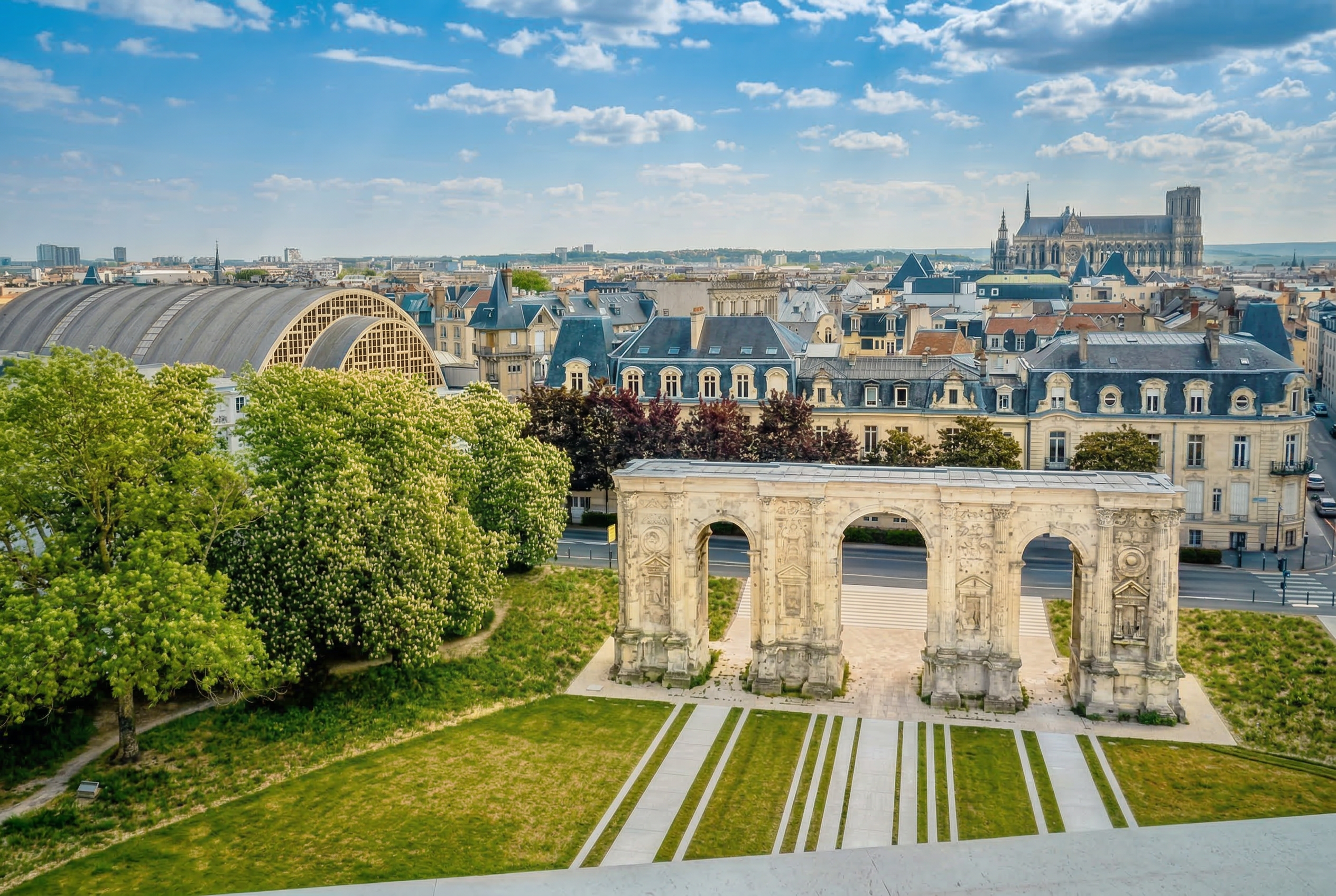
It has been standing for 1,800 years, and it shows no signs of age. The Mars Gate is one of the largest Roman triumphal arches still standing in the world: 33 metres wide, three majestic arches, bas-reliefs depicting Romulus and Remus, Jupiter and Leda. It was once one of four great gates into the Roman city. Today it stands in the city centre, as though eighteen centuries simply passed it by. Remarkable.
 Cryptoporticus — view 1
 Cryptoporticus — view 2
 Mars Gate
Less famous than its neighbour the cathedral, the Basilica of Saint-Remi predates it by two centuries — and in many ways, it is the more moving of the two. It was here, around the tomb of Saint Remigius, that everything began: around 496–498 AD (the exact date remains debated among historians), the bishop baptised Clovis, king of the Franks, making Reims the spiritual cradle of a nation not yet called France. The Holy Ampulla, kept here, was used to anoint kings at their coronations. Its Romanesque and Gothic architecture — sober, powerful — commands quiet reverence. A foundational place.
It is hard to write about Reims without writing about the cathedral. Harder still to avoid superlatives. So here they are: it is one of the absolute masterpieces of French Gothic architecture, with its 2,303 sculptures, its stained-glass windows including several signed by Marc Chagall, and its nave rising 38 metres — while the exterior towers reach 81 metres. Twenty-five kings of France were crowned here, from Louis VIII in 1223 to Charles X in 1825. Bombed and set ablaze in 1914, partially destroyed, it was painstakingly restored thanks in large part to the patronage of John D. Rockefeller. Its resurrection is, in its own way, another Reims miracle.
 Basilica of Saint-Remi
 Notre-Dame Cathedral
Standing directly beside the cathedral, the Palais du Tau is its earthly counterpart. Its origins date back to the 4th century, and it was here that kings would don their ceremonial robes before the coronation, and feast in the great hall afterwards. It was in the 17th century that the building took its current form, extensively remodelled between 1671 and 1710 by Jules Hardouin-Mansart — the architect of Versailles. Today it houses the Museum of the Coronations, where the cathedral's statuary and tapestries are kept alongside an exceptional royal treasury. Listed alongside the cathedral and Saint-Remi as a UNESCO World Heritage Site, the three together form an irreplaceable triptych.
Tucked away on the Place du Forum, steps from the Roman cryptoporticus, the Hôtel du Vergeur is one of the oldest civil buildings in Reims. Its origins date to the 13th century, when the Forum neighbourhood was home to the city's wealthy merchants. In the 16th century, Nicolas Le Vergeur — a bourgeois who had prospered from the salt tax — transformed it, giving it the Renaissance façades arranged around an inner courtyard that still stand today: an architectural gem that weathered wars and centuries without losing its soul.
But it is the building's last private owner, Hugues Krafft, who gave it its extraordinary dimension. This inveterate traveller, who founded the Société des Amis du Vieux Reims in 1909, bought the building in 1910 to save it from neglect. After the bombardments of the Great War left the building badly damaged, he patiently oversaw its restoration — and went further still: he created in the garden a kind of open-air architectural museum, gathering façades, doorways and fragments from Reims buildings destroyed in the war, rescuing from oblivion what the bombs had spared. At his death in 1935, he bequeathed everything to his association. The museum today holds two complete series of original engravings by Albrecht Dürer — the Apocalypse and the Great Passion — alongside collections of furniture and decorative arts spanning the 18th to early 20th century. A discreet, intimate, and deeply moving place.
This is one of Reims's best-kept secrets. Founded in 1617 by the Society of Jesus to educate the intellectual and religious elite, the college houses one of the finest Baroque libraries in France: original period woodwork, a painted ceiling, centuries of silence and leather-bound volumes. After the Jesuits were expelled in 1762, the building became an imperial lycée, then a municipal one. Since 2010, it has been home to the Reims campus of Sciences Po Paris — which, when you think about it, is a striking historical continuity: the Jesuits trained the elites of the 17th century; Sciences Po trains those of the 21st. Same place, same purpose. Only the access has broadened.
Its history mirrors Reims itself: rich, layered, and scarred by war. The foundation stone was laid in 1627; the Baroque façade inaugurated in 1636. But construction dragged on until 1880. Then came 1917: the bombardments set the building ablaze, leaving only the outer walls standing. The interior was entirely rebuilt in the 1920s in Art Deco style, a striking contrast to its Baroque shell. The result is a building that is simultaneously of the 17th century and the 1920s — an architectural mille-feuille that tells the fractures of history better than any book.
 Palais du Tau
 Hôtel du Vergeur
 Jesuit College
 City Hall
Designed by architect Narcisse Brunette and inaugurated on 21 April 1867, the Circus of Reims is one of the last surviving permanent circus buildings of the 19th century in France. Equestrian shows, cinema from 1896, boxing, wrestling — it has seen it all. Today converted into a national stage under the name Le Manège, it hosts contemporary circus, dance and movement arts — a pleasing faithfulness to its original spirit. Listed as a historical monument in 1994, it is one of the most overlooked buildings in the city, and one of the most endearing.
No account of 19th-century cultural life in Reims would be complete without its Opera House. Designed by the same Alphonse Gosset — the unavoidable architect of bourgeois Reims — in collaboration with Narcisse Brunette and Ernest Leclère, it was inaugurated in 1873. Gosset drew inspiration from the plans of the future Palais Garnier in Paris, then still under construction: the same gradation of rooflines between foyer, auditorium and stage, a similar organisation of the façade. The means and the scale are naturally not the same — and the result is a more restrained, more Rémois Neoclassical hall, with its 1,200 seats and circular frieze dedicated to the theatrical arts. Like so many buildings in Reims, it survived the Great War only as a shell: the interior was entirely rebuilt between 1931 and 1932, with a monumental 7.5-metre chandelier by Edgar Brandt and an Art Deco interior evoking the Théâtre des Champs-Élysées. The result: a Neoclassical envelope around a resolutely modern heart. Still in full operation today, it welcomes operas, ballets and concerts in a setting of red velvet and gold.
 Hôtel de Brimont
 Circus of Reims
 Opera House — façade
 Opera House — interior
A gem of transition between Art Nouveau and Art Deco, Villa Demoiselle was built between 1904 and 1908 for Henry Vasnier, director of Maison Pommery and passionate art collector, who dreamed of a home that could house his collection like a private museum. Architect Louis Sorel broke new ground by building the villa on a steel and concrete frame — a first for the era. Elegant façades, elaborate ironwork, botanical interior decoration: everything here breathes the total artwork that Vasnier had envisioned. He died in 1907, before seeing it completed. Left to ruin in the 1980s and threatened with demolition, it was saved and fully restored by Paul-François and Nathalie Vranken from 2004 onwards. A fine story of heritage rescue.
In 1919, as Reims emerged in ruins from four years of bombardment, the Carnegie Foundation funded the construction of a library as a symbol of cultural rebirth. Building work continued until 1928; the inauguration took place in 1930. This act of international solidarity — coming from America — carries something deeply moving: rebuilding knowledge before rebuilding stone. The building, sober and elegant, is today a thriving public media library.
If the cathedral is the symbol of medieval Reims, the Boulingrin Market Hall is the symbol of 20th-century renewal. Designed by architect Émile Maigrot and inaugurated in 1929, it owes its structural feat to engineer Eugène Freyssinet: a parabolic concrete vault just 7 centimetres thick, with a 38-metre span, covering a rectangular space of 49 by 109 metres. No central pillar, light as an eggshell. Fallen into disuse and threatened with demolition in the 1980s, it was saved by a listing as a historical monument in 1990 and restored in 2012. A testament to the audacity of a city rebuilding itself after the devastation of 1914–1918, it still pulses today with a market and cultural events.
Rebuilt in Art Deco style after the original 1858 station was destroyed, Reims railway station was inaugurated in 1934. It is often the first thing visitors see when arriving by train — and it is a fine introduction: clean lines, controlled geometry, pale stone. It sets the tone for a city that chose, in the wake of wartime devastation, elegance and modernity over nostalgia.
 Villa Demoiselle
 Carnegie Library
 Boulingrin Market Hall
 Railway Station
Small in scale but immense in emotional power, the Foujita Chapel is one of Reims's hidden treasures. Built from 1964 at the initiative of René Lalou, president of Champagne Mumm and godfather of the painter, it was entirely designed and decorated by Léonard Foujita himself — in his eighties. Between June and August 1966, he painted its frescoes directly onto wet cement, with no possibility of going back: 200 square metres of biblical compositions of extraordinary delicacy, weaving his Japanese sensibility into the visual language of the Italian Renaissance. Consecrated on 1 October 1966, the chapel is the artistic testament of a man of faith. Foujita is buried here, as he wished. A place that even non-believers leave moved.
 Chapel — exterior
 Chapel — The Last Supper
 Chapel — stained glass
Housed since 1913 in the 18th-century buildings of the former Abbey of Saint-Denis, steps from the cathedral, the Reims Museum of Fine Arts holds one of the most prestigious collections among French regional museums: thirteen portraits by Cranach the Elder and Younger, a Corot collection rivalled in France only by the Louvre, masterworks of Impressionism and Art Deco, and more than 1,300 drawings by Foujita bequeathed by his heirs — making it the natural museum counterpart to the nearby chapel.
Closed since 2019 for renovation, it is undergoing an ambitious transformation entrusted to Portuguese architects Francisco and Manuel Aires Mateus — €45 million, tripled exhibition space, and a clear philosophy: not to erase the past, but to reveal it. The project redraws the former abbey cloisters in a spare, contemporary gesture, opens the museum onto the city with two freely accessible courtyards, and frames a direct view of the cathedral from the entrance. The centrepiece? The Golden Rift — a long staircase clad in gold leaf, carved into the main courtyard, symbolising the passage between old and new, and a nod to the famous chalk cellars that run beneath the city.
Perhaps this project says best who Reims is: a city that does not build beside its heritage, but within it. Reopening expected late 2027 — a good reason to come back.